Home › Salt Lake City › Frozen or burst pipe
Frozen or Burst Pipe in Salt Lake City: What to Do Right Now and Next
Do this now
- Shut off the main water valve. If a pipe is spraying or leaking, this is the fastest way to stop the damage.
- Stay away from wet outlets and cords. Turn off power to wet areas only if you can reach the breaker without standing in water.
- Drain the lines. Once the water is off, open the lowest faucet in the house.
- No water at all? Call Salt Lake City Public Utilities dispatch at 801-483-6700, 24 hours a day, to check whether the problem is on the city's side.
- Take photos and video before you clean up, if it's safe.
- Start drying within hours, not days. The EPA says wet areas should be dried within 24 to 48 hours to help prevent mold.
You turn on the kitchen tap on a frigid morning and get nothing. Or worse, you hear water running inside a wall, or see a stain spreading across the ceiling. Your heart sinks. You're wondering how bad it is, who to call, and what this is going to cost.
Take a breath. You can usually fix a frozen pipe, and you can contain a burst one if you move quickly. Here's what to do in the first few minutes, and what comes next.
We're a free referral service, not a restoration company. When you call through our site and get connected to a provider, our call-routing partner pays us for that call. We don't control providers' prices or billing.
First: Is your pipe frozen or burst?
The answer changes what you do next.
- Frozen: A faucet gives only a trickle or nothing at all, and you may see frost on an exposed pipe.
- Burst: Water is spraying, dripping, or pooling, or you hear running water when every tap is off.
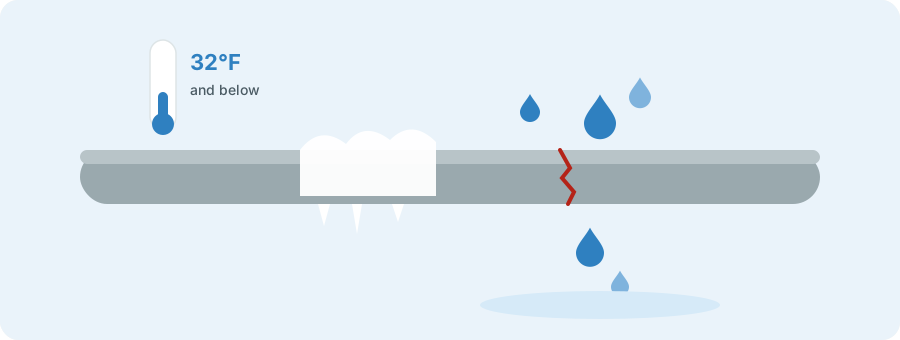
A frozen pipe can turn into a burst pipe. Water expands as it freezes, and that pressure can break even a strong pipe, according to the American Red Cross. Often you don't see the leak until the ice starts to melt. That's what happened to Graywhale, a Taylorsville music store, during the January 2023 cold snap. The owner told KSL that a fire suppression pipe froze in single-digit temperatures, then burst as it thawed (KSL, 2023). So keep an eye on a frozen pipe while it thaws.
If a pipe has burst: the first 15 minutes
1. Shut off the main water valve

Find your main shutoff valve and close it. It's often in the basement, a utility room, or a crawl space, near where the water line enters the house. If it's a round handle, turn it clockwise until it stops. If it's a lever, turn it so it sits across the pipe.
If you can't find it or it won't budge, call a plumber right away.
2. Be careful with electricity
Federal guidance from Ready.gov says, "Do not touch electrical equipment if it is wet or if you are standing in water." It also says to turn off the electricity to prevent shock "if it is safe to do so."
In plain terms, don't walk into a flooded basement if outlets or cords might be under water. Turn off the breaker only if you can reach the panel while standing on dry ground. If water is near the panel, stay away and call an electrician. If anyone is hurt or in danger, call 911.
3. Drain the lines
With the main valve closed, open a faucet on the lowest level of your home. This lets the water left in the pipes run out instead of leaking.
4. Move what you can, then take photos
Lift rugs, electronics, boxes, and important papers off wet floors and move them somewhere dry. Before you clean up, photograph the leak and the damage (more on that below).
Who to call: the city, a plumber, or a restoration company?
| What's happening | Who to call |
|---|---|
| No water anywhere in the house, and you don't know why | Salt Lake City Public Utilities dispatch, 801-483-6700 (24 hours) |
| Water main break in the street, or sewage backing up | Salt Lake City Public Utilities dispatch, 801-483-6700 |
| A pipe burst or leaked inside your home | Shut off the main valve, then call a licensed plumber |
| You can't find or thaw the frozen pipe | A licensed plumber |
| Wet drywall, carpet, or standing water after the leak is stopped | A water damage restoration company |
| Water near the electrical panel | An electrician |
| Someone is hurt or in danger | 911 |
When to call the city. The city lists water main breaks, sewage backups, and flooding among the emergencies to report to its 24-hour dispatch line (Salt Lake City Public Utilities). For frozen pipes, dispatch can help you figure out whether the problem is on your side or the city's. If water is out in only part of your home, the city calls that a "premise plumbing issue," which is the customer's responsibility to fix (Salt Lake City Public Utilities). In other words, it's your plumbing, and you'll need a plumber.
Not sure who supplies your water? Check your water bill. If it isn't from Salt Lake City Public Utilities, call the provider listed there.
When to call a plumber. A plumber fixes the broken pipe. The Red Cross says to call a licensed plumber if you can't find the frozen spot, can't reach it, or can't thaw it.
When to call a restoration company. A plumber stops the leak but usually doesn't dry out your house. If water soaked into drywall, carpet, or a ceiling, a restoration crew can pull out water, run fans and dehumidifiers, and check moisture until things are dry.
How to thaw a frozen pipe safely

If no pipe has burst, you may be able to thaw it yourself. Salt Lake City Public Utilities suggests these steps (Salt Lake City Public Utilities):
- Open all cold-water taps so a trickle can flow.
- Open cabinet doors and doors to rooms with water pipes, so warm air can reach them.
- Use a hair dryer on the pipe where water enters your home. Keep it moving. Don't point it at one spot, and don't leave it running unattended.
- Once water flows, leave a faucet running at about "a spaghetti strand width of flow" so it doesn't freeze again.
- Still no water? Call dispatch at 801-483-6700.
Before you start, check whether a garden hose is still attached outside. The city notes that water in a connected hose can freeze, and the freeze can spread to the pipe inside.
The Red Cross says an electric heating pad, a space heater kept away from anything that can burn, or towels soaked in hot water can also work. Keep heating until full water pressure comes back. Then check your other faucets, because one frozen pipe can mean others are frozen too (American Red Cross).
Never use an open flame. The Red Cross says, "Do not use a blowtorch, kerosene or propane heater, charcoal stove, or other open flame device." A flame can start a fire inside your walls, and it can also damage the pipe.
Signs a pipe burst inside a wall or ceiling
Pipes inside walls and ceilings can leak quietly for hours. Watch for:
- Stains or brown rings on ceilings or walls
- Paint that bubbles or peels, or drywall that feels soft or sags
- Warped wood floors or a new musty smell
- The sound of running water when nothing is on
- A water bill that's higher than usual
One simple test: turn off every faucet and appliance that uses water, then look at your water meter. If the numbers or the small dial keep moving, water is going somewhere. Call a plumber to find the leak.
Why Salt Lake City gets so many frozen pipes
Salt Lake City has real winters. On average, the city has about 118 nights a year at or below freezing, and January's normal low is around 24°F (National Weather Service Salt Lake City).
Cold snaps can hit hard. During the cold snap on January 31, 2023, Salt Lake City's Department of Public Utilities got more than 130 calls about frozen pipes, FOX 13 reported (FOX 13, 2023). Sandy officials said they responded to around 40 calls in just one day (KJZZ, 2023).
The cold hits the city's pipes, too. In October 2024, Salt Lake City officials warned of more water main breaks in winter, because cold snaps make the ground contract and stress pipes. The city had 438 main breaks from July 2022 to June 2023, FOX 13 reported (FOX 13, 2024). If you see water bubbling up in the street, call dispatch.
The pipes most at risk are in cold spots: outdoor hose bibs, sprinkler lines, and pipes in unheated basements, crawl spaces, attics, garages, under kitchen cabinets, and along outside walls with little insulation (American Red Cross).
Drying out: why the clock matters

Once the leak is stopped, the next goal is getting everything dry. The EPA says, "It is important to dry water-damaged areas and items within 24-48 hours to prevent mold growth" (US EPA).
That doesn't mean everything will be fully dry in two days. Water soaks into drywall, insulation, carpet padding, and wood framing, and drying it out can take several days, even with fans and dehumidifiers. Ask the crew to measure moisture each day and show you the readings, so you know when it's done.
While you wait, don't paint over or patch wet drywall. It can trap moisture and hide mold.
If you see mold, the EPA says you can usually clean a patch smaller than about 10 square feet yourself. For bigger areas, it points to more detailed cleanup guidance. If sewage or other dirty water caused the damage, it suggests calling a professional with experience in that kind of cleanup (US EPA). If you have health concerns, talk to a health professional before you start.
Documenting the damage for insurance
Many homeowners policies cover water damage from a pipe that bursts suddenly, but policies differ, and damage from a slow leak may be treated differently. Before cleanup:
- ☐ Take wide photos and a short video of each room, then close-ups of the damage.
- ☐ Keep the broken section of pipe if the plumber removes it.
- ☐ Save receipts for the plumber, fans, hotel stays, and anything else you pay for.
Call your insurance company soon to start the claim. Our guide to water damage insurance claims in Utah explains what's usually covered, how to document the loss, and what to do if the payout seems too low.
Choosing help without getting rushed
After a burst pipe, you may feel pressured to sign the first contract you see. You don't have to. Even in an emergency, ask a few quick questions:
- If they'll do repairs, do they hold a Utah contractor license? You can check on the state license lookup.
- How will the price be set, and can you see it in writing before you sign?
- Does the paperwork sign over your insurance payments to them?
Our guide on how to pick a water damage company you can trust walks through the red flags and a full checklist. And if the work is done but the bill is bigger than what insurance paid, see what to do when a restoration bill is higher than your insurance payout.
Prevent it before the next cold night
A few minutes of prep can save you a lot of stress. Salt Lake City Public Utilities recommends (Salt Lake City Public Utilities):
- ☐ Open cabinet doors under sinks so warm household air can reach the pipes.
- ☐ Set the thermostat above 65°F if you'll be away for several days.
- ☐ Keep an attached garage door closed.
- ☐ On very cold nights, let the faucet farthest from where water enters the house drip slowly. Put a bucket under it to save the water.
A few more steps:
- ☐ Disconnect garden hoses from outdoor spigots.
- ☐ Keep the thermostat at the same temperature day and night during a cold snap (American Red Cross).
- ☐ Find your main shutoff valve today, and make sure everyone at home knows where it is.
- ☐ Ask a plumber about insulating pipes in a crawl space, garage, or along outside walls.
Frequently asked questions
Should I call the city or a plumber if my pipes freeze in Salt Lake City?
If you have no water anywhere in the house, call Salt Lake City Public Utilities dispatch at 801-483-6700 to check whether the problem is on the city's side. If some cold-water taps still work, the city considers it your home's plumbing, so call a plumber.
How long do I have before mold starts?
The EPA says to dry water-damaged areas and items within 24 to 48 hours to help prevent mold. The sooner you start, the better.
Do I need a restoration company, or just a plumber?
A plumber fixes the pipe. If water soaked into walls, ceilings, carpet, or floors, or if there's standing water, a restoration company can dry the structure. For a small spill on a hard floor that you can wipe up right away, you may not need one.
Related guides
- Salt Lake City water damage help: first steps and who to call
- How to vet a restoration company in Salt Lake City
- Filing a water damage claim in Utah
Sources (checked November 2026)
- Salt Lake City Public Utilities, "Thawing Frozen Pipes": https://www.slc.gov/utilities/thawing-frozen-pipes/
- Salt Lake City Public Utilities, "Prevent Frozen Pipes": https://www.slc.gov/utilities/prevent-frozen-pipes/
- Salt Lake City Public Utilities, "Utilities and Services": https://www.slc.gov/utilities/utilitiesandservices/
- American Red Cross, "Preventing & Thawing Frozen Pipes": https://www.redcross.org/get-help/how-to-prepare-for-emergencies/types-of-emergencies/winter-storm/frozen-pipes.html
- Ready.gov, "Floods": https://www.ready.gov/floods
- US EPA, "A Brief Guide to Mold, Moisture and Your Home": https://www.epa.gov/mold/brief-guide-mold-moisture-and-your-home
- National Weather Service Salt Lake City, "Salt Lake City Climate Book": https://www.weather.gov/slc/climatebook
- FOX 13, "Salt Lake area residents experience water issues due to frozen pipes" (January 31, 2023): https://fox13now.com/news/local-news/salt-lake-area-residents-experience-water-issues-due-to-frozen-pipes
- KJZZ, "Officials in Utah towns respond to dozens of frozen pipe calls amid frigid temps" (January 31, 2023): https://kjzz.com/news/local/multiple-towns-responded-to-dozens-of-frozen-pipe-calls
- KSL, "Taylorsville music store temporarily closed by broken pipes, flooding" (February 1, 2023): https://www.ksl.com/article/50569559/taylorsville-music-store-temporarily-closed-by-broken-pipes-flooding
- FOX 13, "Salt Lake City officials warn of water main breaks as winter approaches" (October 16, 2024): https://fox13now.com/news/local-news/northern-utah/salt-lake-city-officials-warn-of-water-main-breaks-as-winter-approaches
- Utah Division of Professional Licensing, License Lookup: https://secure.utah.gov/llv/search/index.html
Update log
- November 6, 2026: First published.