Home › Salt Lake City › Choosing a company
How to Choose a Water Damage Restoration Company in Salt Lake City (and Spot Red Flags)
Do this now
- Get the water stopped first. Close your main shutoff if you can, and stay out of wet areas near outlets or cords.
- Photograph everything before a crew moves furniture or cuts out drywall.
- Call your insurance company yourself, and write down the claim number.
- Look up the company's Utah license on the state's free DOPL lookup before work goes past basic drying.
- Read the work authorization before you sign it. If the price section is blank, stop and ask.
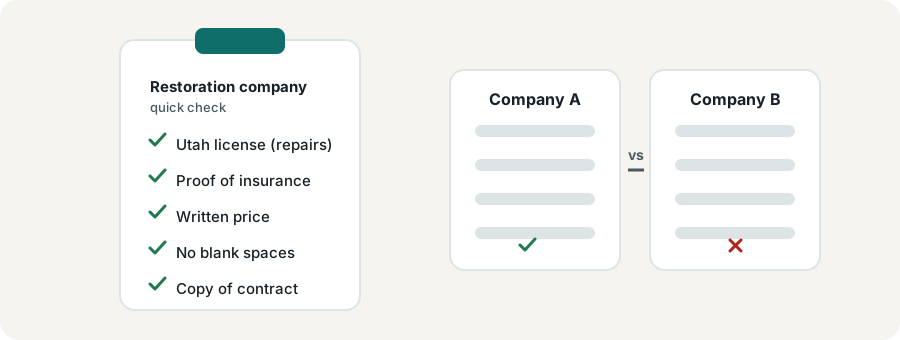
When water is spreading across your floor, every minute feels expensive. Maybe a pipe let go during a cold snap, like the ones in our frozen pipe guide, and now you're scrolling through ads while your carpet soaks. That rush is when people sign things they regret. Vetting a company doesn't take hours, though. A few quick lookups and the right questions go a long way.
We're a free referral service, not a restoration company. When you call through our site and get connected to a provider, our call-routing partner pays us for that call. We don't control providers' prices or billing.
This is general information, not legal advice. For advice about your situation, talk to a Utah attorney.
Start by asking who sent them
First, ask how the company found you, or how you found it. The Utah Insurance Department warns homeowners not to rely on a plumber or anyone else who refers them to a water mitigation company. It says some plumbers have received as much as $1,000 for a referral, and it suggests finding out whether your plumber will get a referral fee (Utah Insurance Department, 2025).
That applies to us, too: BluePeak Media gets paid when a call through our site connects you with a provider. A referral fee doesn't make a company bad, but you deserve to know.
The same warning suggests asking your insurer for its list of "preferred" companies and searching online for complaints. If someone shows up at your door uninvited, slow down. The Better Business Bureau says to be suspicious of contractors who contact you unexpectedly or go door to door (BBB).

Step 1: Check the Utah contractor license
Drying vs. rebuilding: what needs a license
Water damage jobs usually come in two stages: mitigation (pumping out water, pulling wet carpet, running fans and dehumidifiers) and the rebuild (new drywall, flooring, cabinets, and paint).
Utah's Construction Trades Licensing Act covers work like building, remodeling, repairing, or tearing down a structure. That's true both now and under the rewritten version of the law that takes effect January 1, 2027 (Utah H.B. 40, 2026). The law doesn't mention water extraction or drying by name, and we didn't find DOPL guidance that settles whether drying alone needs a license. So a crew that only dries your home may not need one. But tearing out and rebuilding walls and floors is the kind of work the law describes. If you're unsure which side of that line your job falls on, call DOPL's contracting line at 801-530-6628.
Two more Utah rules are worth knowing:
- Small jobs have an exemption. Through December 31, 2026, work valued under $7,000, labor and materials combined, is generally exempt from contractor licensing. If the job is over $3,000, the worker must file a statement with DOPL that they carry liability insurance (and workers' comp, if it applies) (Utah Code 58-55-305). Starting January 1, 2027, this rule moves to Utah Code 58-55-110. The $7,000 limit stays, but changes to the agreed work count toward it, and a worker on a job over $3,000 must register with the state and send DOPL proof of insurance (Utah H.B. 40, 2026). Repairs can pass $7,000 fast.
- Plumbing and electrical are different. Even on an exempt job, work on plumbing or electrical systems generally must be done by a licensed plumber or electrician (Utah Code 58-55-305). Starting in 2027, the small-job exemption also won't cover gas appliances, heating and air conditioning, fire sprinklers, or radon systems (Utah H.B. 40, 2026). If your burst pipe needs fixing, ask who will do that part.
How to use the DOPL lookup
Go to DOPL's Licensee Lookup and Verification page. You can search by name, check "Contractor" to narrow the results, or enter a license number if the company gave you one (Utah DOPL).
On the listing, check three things:
- The status is active. DOPL notes that licenses on probation now show as "Active on Probation." If you see that, it's fair to ask the company why.
- The name matches your paperwork. The business on the license should be the business on your contract.
- The license fits the work. Ask the company which license covers the rebuild, not just the drying.
Licensing matters later, too. Utah's Residence Lien Recovery Fund protections generally apply only if you had a written contract with a licensed or exempt contractor and paid the full contract price, among other conditions (Utah DOPL). If you're already dealing with a bill or lien, see our guide on what to do when the restoration bill tops your insurance payout.
Step 2: Get proof of insurance
You want two kinds of coverage on any crew working in your home:
- General liability insurance helps pay if the crew damages your property. To get a Utah contractor license, DOPL requires liability coverage of at least $100,000 per incident and $300,000 total (Utah DOPL).
- Workers' compensation covers employees who get hurt on the job at your house.
How to ask: Say, "Please have your insurance agent email me a certificate of insurance." A certificate that comes straight from the agent is harder to fake than a PDF the company forwards. Check that the business name matches your contract and that the dates cover your job.
For workers' comp, the Utah Labor Commission links to a free proof-of-coverage search run by the National Council on Compensation Insurance. The commission notes that the results aren't a legal verification, so treat them as one more check, not the final word. Its compliance staff can be reached at 801-530-6800 (Utah Labor Commission).
Step 3: Understand what IICRC certification means
The IICRC (Institute of Inspection, Cleaning and Restoration Certification) is a nonprofit that certifies technicians in the cleaning and restoration trades. An IICRC Certified Firm is a business that employs one or more IICRC-certified technicians (IICRC). The group also publishes the S500, a widely used standard for professional water damage restoration (ANSI Webstore).
What it tells you: At least one person at the company holds an IICRC certification.
What it doesn't tell you: It isn't a state license, it doesn't mean the person at your door is certified, and it says nothing about fair pricing. Ask, "Will a certified technician be on my job?" You can verify a firm on the IICRC Global Locator or by calling 844-464-4272 (IICRC).
Step 4: Read reviews the smart way
Check the company's BBB profile and recent reviews, and read past the star rating. Did the company answer complaints? Several reviews about surprise bills tell you more than one angry post. The BBB also suggests calling references (BBB).
Questions to ask on the phone
A company that does good work can answer these without getting annoyed.
- What's your Utah DOPL license number, and what type of license is it?
- Who will do the repairs after drying: your crew, a subcontractor, or someone I hire?
- Can your insurance agent email me certificates for liability and workers' comp?
- Will an IICRC-certified technician be at my house?
- How do you set prices? Can I see a price list or a written estimate before you start?
- If my insurance doesn't pay the full bill, what will I owe, and will you put that in writing?
- Will you send me daily moisture readings, an equipment list, and photos?
- What deposit do you need, and when is each payment due?
- Does anyone get paid for referring me to you?
Note the answers, the person's name, and the time of the call.
What a fair work authorization should say

Most crews ask you to sign a work authorization before they start. That's normal. Signing one you haven't read is how a lot of billing fights start.
The Utah Insurance Department specifically warns against agreements that leave the price unknown and make you "responsible for all costs that your insurance company does not pay" (Utah Insurance Department, 2025).
A fair agreement should include:
- The company's legal name and license number, matching what you found on DOPL.
- How the price is set: a written estimate, a price list, or a clear rate. If the company prices with the same software your insurer uses, the agreement should say so.
- What you'll owe if insurance pays less than the bill.
- When interest, late fees, or cancellation fees start. The BBB warns that cancellation fees and "liquidated damages" can be buried in the fine print (BBB).
- The scope of work, such as drying only, or drying plus repairs.
- No blank spaces. Draw a line through anything left empty before you sign.
Watch for language that signs your insurance benefits over to the company, often called an "assignment of benefits." It can change who deals with your insurer and who gets paid. Before you agree to that, learn how it works when you start your Utah water damage claim.
Can you cancel? Utah's three-day rules
The answer depends on who made the first contact.
If the company came to you. Under Utah's Consumer Sales Practices Act, a sale over $25 made through a seller's personal contact, away from its regular place of business, generally must come with a written notice that you may cancel before midnight of the third business day. The notice must appear in bold on the first page (Utah Code 13-11-4; Utah Admin. Code R152-11-9). The federal Cooling-Off Rule gives a similar three-day right for many sales made at your home (FTC).
If you called them in an emergency. Your rights may be narrower. The FTC rule leaves out emergency sales, but only when you started the contact and gave the seller a separate, signed, dated statement in your own handwriting that describes the emergency and gives up your right to cancel (16 CFR 429.0). Utah's law for home sales made on credit also limits canceling once you've asked for emergency work and the seller has substantially started (Utah Code 70C-5).
If you want out of a contract you signed in a panic, act fast, cancel in writing, and keep a copy. A Utah attorney can tell you which rule fits.
Red flags and what to do instead
| Red flag | Why it matters | What to do |
|---|---|---|
| "Just sign here so we can start" | You may agree to open-ended pricing | Read the price section first |
| No license number, or a name that doesn't match DOPL | The rebuild may be unlicensed, which can affect your lien protections | Look it up before repairs begin |
| "Insurance will pay for all of it" | No one knows that until your insurer decides | Ask what you'll owe if it doesn't, in writing |
| Knocking on your door after a storm or cold snap | The BBB says to be very suspicious of contractors who go door to door | Call companies you chose yourself |
| Won't email an insurance certificate | You can't confirm coverage if someone gets hurt or something breaks | Ask the agent to send it directly |
| Wants full payment or cash up front | The BBB urges caution about paying for the whole job in advance | Keep the deposit small and pay by check or card |
| Warns of a mold disaster over a small spot | The EPA says homeowners can usually clean mold patches under about 10 square feet themselves (EPA) | Get a second opinion before paying for big extras |
Printable checklist
- ☐ Water shut off, and no one is near wet outlets or cords
- ☐ Photos and video taken before cleanup started
- ☐ Insurance claim opened (claim number: ________)
- ☐ Asked how the company found me and whether anyone gets a referral fee
- ☐ Company license checked on DOPL's lookup (license number: ________)
- ☐ Liability and workers' comp certificates received from the insurance agent
- ☐ IICRC status checked on the Global Locator
- ☐ BBB profile and recent reviews read, including complaints
- ☐ Written estimate or price list received before work began
- ☐ Work authorization read, blanks crossed out, and a copy kept
- ☐ Deposit kept small, with no cash payments
- ☐ Daily moisture readings and equipment counts requested
- ☐ Final invoice reviewed before signing a completion form
Frequently asked questions
Does a water damage company in Utah need a contractor license?
It depends on the work. Utah's licensing law covers building, remodeling, repair, and demolition, but it doesn't name water extraction or drying (Utah H.B. 40, 2026). Rebuilding work generally needs a license unless an exemption applies, such as the one for jobs under $7,000 (Utah Code 58-55-305). When in doubt, call DOPL at 801-530-6628.
Do I have to use the company my insurer recommends?
Don't assume either way. Read your policy and ask your insurer in writing. The Utah Insurance Department suggests your insurer's preferred list as one place to start (Utah Insurance Department, 2025). Whoever you choose, run the same checks.
I already signed. What now?
Get a copy of what you signed and read the price and cancellation terms. If the company contacted you first, you may have a three-day right to cancel under Utah law (Utah Code 13-11-4). If the work is done and the bill seems too high, our guide to disputing a restoration bill walks you through it step by step.
Related guides
- Salt Lake City water damage: first steps and who to call
- Frozen or burst pipe in Salt Lake City? What to do right now
- Filing a water damage insurance claim in Utah
Sources (checked November 2026)
- Utah Insurance Department, "Don't Get Soaked by Water Mitigation Fraud" (January 17, 2025): https://insurance.utah.gov/?p=19599
- Utah Legislature, H.B. 40, "Utah Construction Trades Licensing Act Amendments" (2026, enrolled; effective January 1, 2027): https://le.utah.gov/Session/2026/bills/enrolled/HB0040.pdf
- Utah Legislature, Utah Code 58-55-305, exemptions from licensure (version effective May 7, 2025; renumbered January 1, 2027): https://le.utah.gov/xcode/Title58/Chapter55/C58-55-S305_2025050720250507.html
- Utah Legislature, H.B. 483, "Construction Trade Amendments" (2024, enrolled; raised exemption to $7,000): https://le.utah.gov/~2024/bills/hbillenr/HB0483.pdf
- Utah Division of Professional Licensing, Licensee Lookup and Verification: https://secure.utah.gov/llv/search/index.html
- Utah Division of Professional Licensing, General Liability Insurance Requirements: https://dopl.utah.gov/wp-content/uploads/2025/10/general-liability-insurance-requirements-instructions.pdf
- Utah Division of Professional Licensing, Residence Lien Recovery Fund FAQs for Homeowners: https://commerce.utah.gov/dopl/residence-lien-recovery-fund/faqs-for-homeowner/
- Utah Labor Commission, Industrial Accidents Resources: https://laborcommission.utah.gov/divisions/industrial-accidents/resources/
- Utah Legislature, Utah Code 13-11-4, Consumer Sales Practices Act (version effective May 6, 2026): https://le.utah.gov/xcode/Title13/Chapter11/C13-11-S4_2026050620260506.pdf
- Utah Admin. Code R152-11-9, Direct Solicitations (via Cornell LII): https://www.law.cornell.edu/regulations/utah/Utah-Admin-Code-R152-11-9
- Utah Legislature, Utah Code Title 70C, Chapter 5, Home Solicitation Sales: https://le.utah.gov/xcode/Title70C/Chapter5/C70C-5_1800010118000101.pdf
- Federal Trade Commission, "Buyer's Remorse: The FTC's Cooling-Off Rule May Help": https://consumer.ftc.gov/articles/buyers-remorse-ftcs-cooling-rule-may-help
- U.S. Government Publishing Office, 16 CFR Part 429, "Rule Concerning Cooling-Off Period for Sales Made at Homes or at Certain Other Locations" (January 1, 2026 edition): https://www.govinfo.gov/link/cfr/16/429?link-type=pdf&year=mostrecent
- IICRC, "What Is an IICRC Certified Firm?": https://iicrc.org/certifiedfirmverification/
- IICRC Global Locator: https://iicrc.org/iicrcgloballocator/
- ANSI Webstore, IICRC S500 Standard for Professional Water Damage Restoration: https://webstore.ansi.org/standards/iicrc/ansiiicrcs5002021
- Better Business Bureau, "Hiring a Restoration Contractor": https://www.bbb.org/article/tips/18677-hiring-a-restoration-contractor
- U.S. EPA, "Mold Cleanup in Your Home": https://www.epa.gov/mold/mold-cleanup-your-home
Update log
- November 6, 2026: First published.